
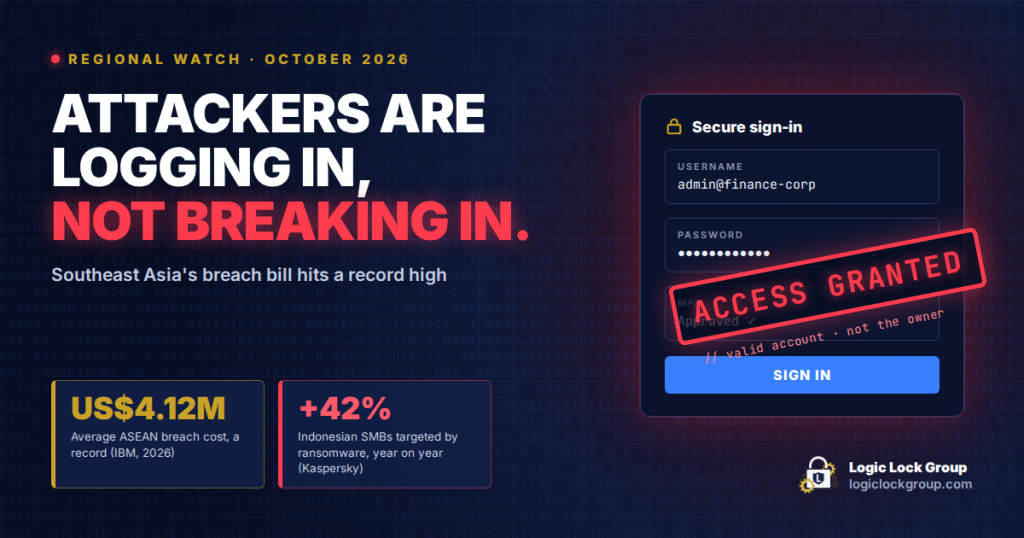
Regional Watch · October 2026
Cyber Security Breach 2026, in Southeast Asia
Managing an enterprise footprint following a major cyber security breach in 2026 has become the single most expensive operational liability for regional organizations. According to recent infrastructure telemetry metrics, the costliest entry point into a Southeast Asian network isn’t an unpatched exploit—it is a valid stolen credential, rendering standard perimeter firewalls completely ineffective.
The Regional Watch thesis
Southeast Asia has entered a period where a single cyber failure means large financial loss, weeks of disruption, regulatory action and follow-on fraud. The priority is not more detection tools. It is reliable control over identities, suppliers and recovery. Organisations waiting for harmonised ASEAN rules will stay exposed while they wait.
US$4.12M
Average ASEAN breach cost, a record high (IBM, 2026)
US$4.5M+
Average cost when the way in was a valid account
+42%
Rise in Indonesian SMBs hit by ransomware, Q1 2026 vs Q1 2025 (Kaspersky)
1. The Cost of a Cyber Security Breach in 2026: A Password at the Front Door
IBM’s 2026 study puts the average cost of a data breach for ASEAN organisations at US$4.12 million, up from US$3.67 million a year earlier and the highest it has recorded. The detail that matters more: breaches that started with abuse of valid accounts averaged more than US$4.5 million, among the costliest entry points in the region. Nearly three in ten organisations hit by a malicious breach said the attack was AI-generated: deepfake, generated phishing, AI-built malware.
Attackers don’t need to break in when they can log in. AI makes the login cheaper to steal, and it makes the request to reset it more convincing.
LLG view: identity is the most expensive way in, and it is also where Southeast Asia has the least local infrastructure. Our latest 2026 Vendor Intelligence research found a region-wide sovereign identity gap. Many organisations are defending their most targeted asset with a control plane that sits outside the region and outside their regulators’ reach.
2. Ransomware moves down-market, fastest in Indonesia and Malaysia
Ransomware is no longer a large-enterprise problem. Across the Southeast Asian SMBs Kaspersky protects, the share targeted by ransomware rose 20% in a single year. In Indonesia it rose 42%: roughly one in every 25 SMBs was targeted in Q1 2026. Malaysia was close behind at 31%. Singapore remains the safest market by far, but even there the rate grew by a fifth.
| Share of SMBs targeted by ransomware | Q1 2025 | Q1 2026 | Change |
|---|---|---|---|
| Indonesia | 2.83% | 4.01% | +42% |
| Malaysia | 2.09% | 2.74% | +31% |
| Singapore | 0.57% | 0.69% | +21% |
| Southeast Asia overall | 2.92% | 3.51% | +20% |
Clop and Qilin were the two most active groups, and newer operators steal data before they encrypt it. That changes the maths for every small business that thinks backups are its ransomware plan: a backup restores your systems, but it does nothing about your customers’ data being published.
Watch: the Japan connection
In early October, Japanese authorities detained a Russian national described as a key member of Qilin and handed him to Germany. Qilin had claimed the 2025 attack that disrupted Asahi Group’s systems. The arrest is a win for cross border enforcement. But Qilin runs on affiliates, so one arrest won’t take it out of Southeast Asia’s SMB market.
3. Indonesia: 182 hostile signals every second
Indonesia’s national cyber agency, BSSN, recorded 5.16 billion traffic anomalies in 2025—averaging roughly 182 hostile signals hitting domestic infrastructure per second. With malware variants accounting for over 93% of these probes, organizations navigating local enforcement parameters must actively stress-test their active incident response plan for cybersecurity to protect multi-vendor cloud layers.
Add the ransomware rise above and enforcement of the Personal Data Protection Law, and Indonesian organisations now face a higher chance of an incident and a higher cost of reporting it badly.
4. Industry spotlight: one telco, two very different incidents
In February 2026, Singapore’s Cyber Security Agency confirmed that the China-linked espionage group UNC3886 had targeted all four major telcos: M1, SIMBA Telecom, Singtel and StarHub. An 11-month defence operation found no evidence that customer data was taken and no service disruption. A strong result.
Seven months later, on 24 September, SIMBA disclosed a separate breach exposing the names, IC numbers, dates of birth, mobile numbers and email addresses of 23,549 customers. The PDPC is investigating. There is no indication the two incidents are connected.
The lesson is not about one company. Telcos hold exactly what fraudsters need to take over everything else: identity numbers, phone numbers and the SIM itself. A telco breach is rarely the end of the story. It is the start of SIM swaps, account takeovers and very convincing phishing aimed at the same customers.
Singapore: resilient, not immune. Its SMB ransomware rate is about one-sixth of Indonesia’s, and still rising. Strong regulation lowers the odds of routine compromise. But a concentration of finance, cloud and data centres also raises the stakes when an attacker does get through.
What to do now
- Secure identities first. Phishing-resistant MFA for every administrator, no standing privileged access, and an inventory of service accounts. Know where your identity platform processes data, not just where it stores it.
- Assume theft before encryption. Immutable backups are necessary but not enough. Add egress monitoring, segmentation and a rehearsed plan for a data-leak threat.
- Protect customers after someone else’s breach. If your customers’ phone numbers or IDs leak from a telco or supplier, tighten SIM-swap checks, step-up verification for account changes and fraud monitoring straight away.
- Standardize cross-border data breach reporting requirements. A single cross-border infrastructure exploit can trigger vastly different regulatory enforcement timelines under Indonesia’s PDP Law, Singapore’s PDPA, and Malaysia’s amended PDPA. Procurement, security and legal compliance teams must pre-write their disclosure playbooks according to these shifting regional data breach reporting requirements before an active crisis hits.
Next in Regional Watch: the governance gap. Southeast Asia is deploying AI agents faster than it is governing them.
Sources
- IBM, Cost of a Data Breach Report 2026: ASEAN (11 Aug 2026)
- Singapore Business Review, Singapore SMB ransomware rate rises despite regional low (Kaspersky Q1 2026 data)
- IT Beat, Kaspersky Q1 2026 SMB ransomware data for Indonesia and the region (13 Jul 2026)
- Jiji Press via Nippon.com, Qilin member held in Japan (6 Oct 2026)
- BSSN 2025 traffic anomaly data, via Periskop (6 Aug 2026)
- The Record, Singapore attributes telecom attacks to UNC3886 (9 Feb 2026)
- CybersecAsia, SIMBA data breach (28 Sep 2026)
