
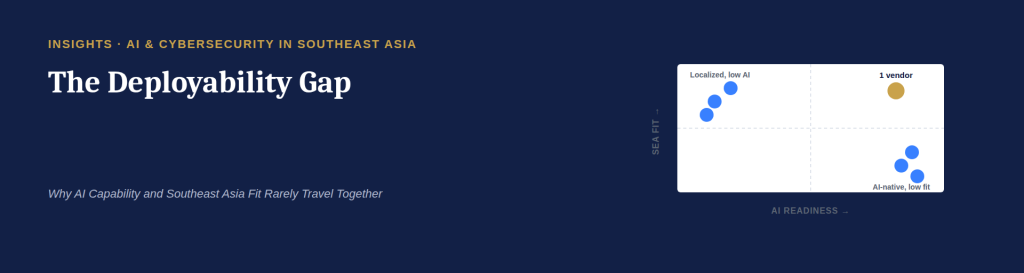
Ask a vendor how AI-native their platform is, and you’ll get a confident answer. Ask the same vendor how well that platform actually deploys across Southeast Asia’s six markets — the residency rules, the talent constraints, the local delivery — and the confidence tends to thin out fast. That’s the deployability gap: the distance between what a platform can technically do and what it can actually do here.
For the full scoring methodology behind this finding, read the AI and Cybersecurity Vendor Intelligence Ledger 2026.
The Deployability Gap in Numbers: Only 1 in 13 Clears Both Bars
Our latest 2026 research scored 13 vendors on two independent axes — AI Readiness and Southeast Asia Fitness — deliberately never blending them into a single composite number. The reason: doing so would hide the exact trade-off that matters most to a buyer.
The finding that came out of that scoring was stark. Of the 13 vendors, only one clears both bars cleanly. The rest split in a consistent, structural way: platforms with the most advanced, autonomous AI analytical engines frequently present the highest hurdles for deployment on sovereign soil. Vendors with deep localized infrastructure, in turn, rarely lead the frontier-model race.
This isn’t a coincidence, and it isn’t a knock against either group.
Why the Trade-off Is Structural, Not a Vendor Failing
Building frontier AI capability and building deep in-region infrastructure pull an engineering org in different directions. Global hyperscalers aren’t slowing down to wait: Microsoft, Alphabet, Amazon, Meta, and Oracle have collectively committed to spending $660–690 billion on AI infrastructure capex in 2026 alone — nearly double what they spent in 2025. That’s exactly the kind of scale that makes frontier AI good. It’s also exactly what makes in-country data residency, local delivery partnerships, and market-specific compliance harder to bolt on later.
Vendors that invested early in Southeast Asia made a different bet — one the region is actively rewarding. Southeast Asia’s data centre market is projected to more than double, from US$13.71 billion in 2024 to US$30.47 billion by 2030, driven in large part by countries like Malaysia and Vietnam enacting data sovereignty laws that require certain data to stay in-region. It shows up as a stronger SEA Fit score. It also means their AI stack usually isn’t the one setting the pace on the frontier.
Neither choice is wrong. But a buyer who only reads the marketing page won’t see the trade-off at all — because almost no vendor’s marketing volunteers which side of this line they’re on.
What This Means for Your Shortlist
The practical implication is simple: don’t evaluate “AI capability” and “Southeast Asia readiness” as one question. They’re two separate purchasing decisions that happen to share a vendor name.
If your environment has severe residency or delivery-layer constraints, a vendor’s frontier AI score matters less than whether it can actually operate in your market. If your priority is autonomous, cutting-edge detection and you can absorb the deployment friction, the calculus flips. Either answer is defensible — but only if you know which side of the deployability gap you’re actually optimizing for before you shortlist.
The Bottom Line
A single vendor scoring well on both axes is currently the exception, not the rule — one out of thirteen, in our fully-scored set. That’s not a market failure; it’s an honest signal about where the industry actually is in 2026. The risk isn’t that this deployability gap exists. It’s shortlisting a vendor without knowing which side of it they’re on. It’s shortlisting a vendor without knowing which side of it they’re on.
Unmasking the 13 Global Security Providers. Knowing that only one single vendor cleanly clears both evaluation axes is a critical market signal. But building a defensible software shortlist requires knowing exactly which side of the deployability line your current incumbents operate on.
Bypass internal engineering overhead and gain immediate access to our technical category quadrants, evidence grading appendices, and multi-market playbooks.
→ Access the latest 2026 Vendor Intelligence Storefront
Logic Lock Group publishes independent cybersecurity intelligence for security and risk leaders across Southeast Asia. → View all Insights.
