
Singapore’s Critical Information Infrastructure operators live under a regulatory regime built on a simple premise: the absence of an alert is not proof of safety. Validation has to be demonstrated on a defined cycle, not assumed because the dashboard is quiet. It is a philosophy, not just a compliance checkbox — and it turns out the market’s own data on agentic SOC adoption across Southeast Asia backs it up independently, in a way most vendor pitches would rather you not look at too closely.
“Zero alerts” was never the same as “secure”
Every MDR and XDR vendor in Southeast Asia is currently selling some version of the agentic SOC — autonomous investigation, AI agents that triage, correlate, and close cases without a human in the loop. The pitch is compelling, and it is not fiction. But if it were the whole story, a straightforward prediction should follow: demand for expensive, human-staffed incident response should be flattening. Instead, incident response retainers are one of the fastest-growing line items in the security services market. Buyers are paying for more human capacity at precisely the moment the marketing says less is needed.
1.7M · 700K
Indonesia’s projected cybersecurity talent shortfall as its digital economy scales, and Vietnam’s projected tech talent deficit — the structural gap agentic MDR exists to cover in this region.
That tension matters more here than almost anywhere else. Southeast Asia’s cybersecurity talent pool is structurally thin relative to demand — most markets in the region simply cannot hire, train, and retain enough tier-one and tier-two analysts to staff a traditional 24/7 SOC at scale. That’s precisely why agentic MDR has landed harder in Southeast Asia than in more talent-rich markets: it isn’t a nice-to-have efficiency gain here, it’s often the only realistic way to get continuous monitoring coverage at all. Which makes the boundary of what that automation actually covers a sharper, more consequential question for SEA buyers than for their counterparts elsewhere.
Because a case is not an incident. Machine autonomy is real at the routine-case tier — and absent at the major-incident tier.
What the evidence actually shows
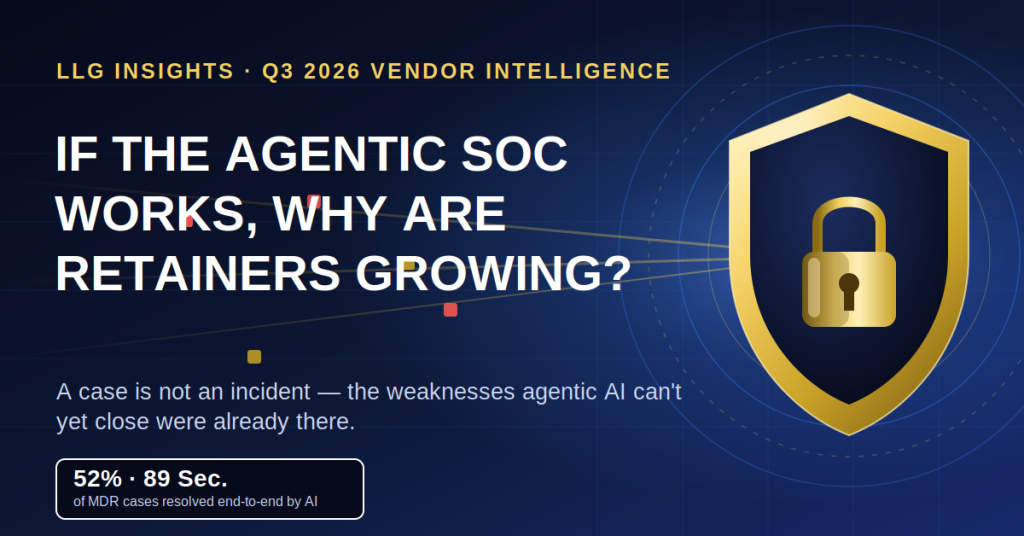
The vendor evidence here is more interesting than a simple “AI doesn’t work yet” story. Sophos reports that 52% of its MDR cases are now resolved end-to-end by AI with no human intervention, at an average of 89 seconds from alert to automated response — currently the strongest vendor-reported evidence in the market for autonomous case handling, though measured and self-reported rather than independently verified as a ceiling.
The closest thing to independent verification of autonomous capability comes from a different vendor entirely: SentinelOne’s MITRE Managed Services evaluation returned 100% detection and the best signal-to-noise ratio in its comparison set, observed by MITRE rather than claimed by the vendor. Either way, the pattern holds across the market: autonomy is real and improving fast at the tier-one and tier-two work Southeast Asia genuinely struggles to staff. It does not yet extend to actual incident response.
52% · 89 SEC
of MDR cases resolved end-to-end by AI, at this average alert-to-response time — a case, not an incident. Human-led DFIR is still needed for the rest.
Why Southeast Asia’s agentic SOC boundary exists
This tier boundary — real autonomy on one side, a hard ceiling on the other — is one of four flagship findings in our latest AI and Cybersecurity: SEA Enterprise Vendor Intelligence Ledger 2026, and our three-way AI decomposition framework (AI-operated, AI-analytical, AI-securing) is what explains it rather than just describing it. Automating the operational and analytical work of a SOC is a tractable, well-scoped problem, and vendors are visibly getting better at it every quarter. Automating the judgment calls of an active, adversary-directed incident — where the next move depends on what a human attacker chooses to do next, not on a pattern already in the training data — is a different category of problem. That is the AI-securing dimension, and it is where the evidence consistently thins out.
The stack, not the champion
This is exactly why vendor selection inside Southeast Asia’s agentic SOC market is increasingly an exercise in assembling a stack rather than picking a single champion. The pattern our report’s CISO Decision Playbooks keep surfacing has three parts: a global AI-native platform chosen for detection and correlation capability, a regional MSSP that supplies in-country presence and named specialisations, and a permanent human DFIR layer — sourced via retainer, managed provider, or regional specialist — that exists precisely because the autonomy boundary makes it necessary, not optional.
This isn’t a hypothesis we’re proposing; it’s already how the market operates. Ensign InfoSecurity delivering CrowdStrike’s platform to an award-winning standard in this region is a working example of the pattern, not a theoretical one. Every buyer we evaluated adds the human incident-response layer the autonomy boundary makes permanent.
Not just a Singapore story
Singapore is ahead on this specifically because its CII regulatory regime already codifies “no alerts isn’t proof of safety” into binding practice. Other Southeast Asian markets haven’t yet written that premise into law in the same way — but the underlying market behaviour driving agentic SOC adoption across Southeast Asia, buyers pairing AI-native platforms with a genuine human DFIR layer, isn’t waiting for regulation to catch up. Expect the same logic now emerging in Singapore’s compliance regime to show up in other SEA markets’ frameworks as they mature. It’s a leading indicator, not a one-off.
What you need to know
- “Zero alerts” from your MDR/XDR platform is not proof of safety — it’s proof of nothing found inside what the system is designed to detect.
- Agentic SOC autonomy is real and improving fast, but it caps out at the routine-to-complex case tier. The best vendor-reported figure in the market is 52% of MDR cases resolved end-to-end by AI; nothing yet earns independent verification beyond that.
- At the major-incident tier — active, adversary-directed situations — human-led DFIR remains the permanent, deliberately procured layer. That’s why incident response retainers keep growing even as agentic SOC/MDR adoption accelerates.
- This gap matters more in Southeast Asia specifically, given the region’s structurally thin cybersecurity talent pool.
- The market’s answer isn’t a single champion vendor — it’s a three-part stack: a global AI-native platform, a regional MSSP, and a permanent human DFIR layer.
What you need to do
- Ask your current or prospective MDR/XDR vendor for their evidence class on autonomous case resolution — vendor-reported (Grade B or below) versus independently verified (Grade A — detailed in our scoring methodology) are very different claims.
- Confirm who owns the major-incident tier in your contract today, and whether that human DFIR capacity is guaranteed or contingent on your existing platform relationship.
- If it’s contingent, evaluate a standalone incident response retainer so your human-led response capability doesn’t disappear the moment you change platforms or vendors.
- Map your current stack against the three-part pattern — AI-native platform, regional MSSP, human DFIR layer — and identify which part, if any, is missing.
- Go deeper. The latest 2026 Vendor Intelligence full ledger maps named vendor combinations to each buyer profile and market.
