
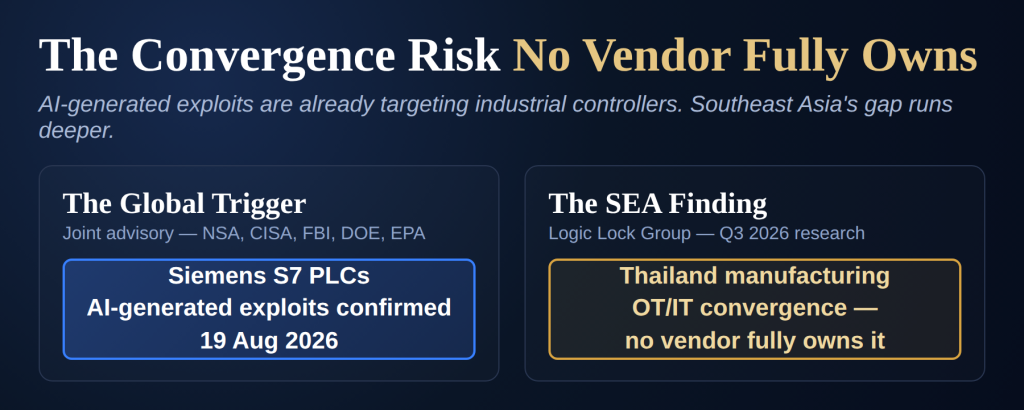
On 19 August 2026, five U.S. federal agencies — NSA, CISA, FBI, the Department of Energy, and the EPA — issued a joint advisory confirming something security teams have warned about for years but rarely seen documented this plainly: threat actors are using AI-generated exploitation scripts to target industrial controllers across critical manufacturing, energy, water and wastewater, chemical, and food and agriculture facilities. Not a proof of concept. An active, ongoing campaign that revealed OT-IT convergence security risk.
The advisory names Siemens S7 Series PLCs specifically. But the underlying story isn’t really about one vendor’s hardware. It’s about what happens when operational technology — the systems that physically run factories, power grids, and water treatment plants — stops being separate from everything else.
How We Got Here
Operational technology was built to be isolated. For decades, OT networks were air-gapped by design: physically disconnected from corporate IT and the internet, because the cost of a breach wasn’t a leaked spreadsheet — it was a halted production line, a disrupted power grid, or a compromised water supply. Isolation was the security model.
Digital transformation broke that isolation deliberately, for good reasons. Connecting OT systems to corporate networks enables real-time production data, predictive maintenance, and remote operations — efficiency gains that are hard to argue against. But every one of those gains widens the same door: previously air-gapped machinery is now reachable from networks that were never designed to protect it.
The OT-IT Convergence Security Risk Isn’t a Bug — It’s Structural
Here’s the detail worth sitting with: the Siemens advisory does not describe a zero-day. There is no single flaw to patch. Attackers are combining known vulnerabilities, weak or default credentials, and unnecessary internet exposure — the kind of gaps that patching alone doesn’t close. Firmware updates exist for the individual vulnerabilities. Applying them wouldn’t be enough on its own, because the deeper problem is architectural: controllers reachable from the open internet, without adequate segmentation from IT networks.
That distinction matters. A single-flaw problem gets fixed with a patch cycle. A structural exposure problem — convergence without hardening — doesn’t go away until the architecture itself changes. And the stakes of getting it wrong are categorically different from an IT breach: the advisory’s own list of potential impacts includes disrupted industrial processes, safety-interlock manipulation, and equipment damage, not just data loss.
| Dimension | Information Technology (IT) | Operational Technology (OT) |
|---|---|---|
| Primary Focus | Data, applications, network infrastructure | Physical machines, assets, and processes |
| Top Priority | Confidentiality and data privacy | Availability, human safety, operational uptime |
| Environment | Offices, data centers, cloud | Factories, power plants, refineries, transport systems |
| Lifecycle | 3–5 years | 10–30 years, often legacy architecture |
| Tolerance for Downtime | Brief interruptions for patching are routine | Near-zero — downtime carries direct financial and safety cost |
That last row is why OT-IT convergence security can’t simply borrow IT’s playbook. A patch cycle that assumes a Tuesday-night reboot window doesn’t map cleanly onto a system that can’t tolerate unplanned downtime at all.
The Evidence Closer to Home
Our latest 2026 research found the same structural gap in Southeast Asia — not as a hypothesis, but as an unserved-market finding. In Thailand, where manufacturing concentration is a defining feature of the economy, the convergence of factory-floor OT systems and corporate IT under digital-transformation programmes has created an attack surface that, as our report puts it, no vendor evaluated in the study fully owns.
The closest fits are hybrid-architecture vendors whose platforms extend into OT environments. But proximity is not coverage — and that’s the finding itself: purpose-built OT-IT convergence security, sized for manufacturing estates, is a requirement Thai buyers currently have to assemble from parts rather than buy as a single, accountable solution.
What You Need to Know
This isn’t only a manufacturing story, even though that’s where our evidenced finding sits. OT runs the water utility, the power substation, and the port logistics system as much as it runs the factory floor — and the Siemens advisory’s sector list (energy, water, chemical, food and agriculture) makes that explicit. If your organisation operates in critical infrastructure, utilities, or transportation and logistics, the same convergence pattern almost certainly applies to you, even without a Southeast Asia-specific incident to point to yet.
One more distinction worth being precise about, because it’s easy to conflate: what’s happening right now is AI being used as a tool by attackers to write faster, more adaptive exploit code against OT systems. That’s evidenced and active today. A related but different frontier — physical AI, where machine learning is embedded directly into the machines themselves, giving them autonomous perception and action — introduces a further layer: securing the AI’s integrity, not just the network and software around it. That’s a real and approaching problem, but treat it as the next chapter, not a claim about what’s already been exploited.
What You Need to Do
- Treat internet-facing OT as compromised until proven otherwise. The Siemens advisory’s own top recommendation is removing direct internet exposure and verifying segmentation — architecture, not just patching.
- Don’t assume your vendor’s IT security coverage extends to OT. Ask directly: does this vendor have OT-specific reference customers, or is OT coverage a claim without deployment evidence behind it?
- Extend this audit beyond manufacturing if you operate in energy, water, logistics, or other OT-heavy sectors — the exposure pattern isn’t manufacturing-specific, even where the clearest evidence currently is.
- Separate the two AI threat vectors in your planning — AI-accelerated attacks against existing OT today, and AI embedded inside OT tomorrow. They need different mitigations and different timelines as OT-IT convergence security risk evolves.
- Bypassing the Vendor IT-OT Security Evaluation Mirage. Verifying whether your security stack can protect physical assets from AI-generated exploit scripts requires unredacted, evidence-graded architecture benchmarks. Our latest 2026 Vendor Intelligence research maps out exactly where global provider capabilities stop and critical asset exposures begin across the Southeast Asian industrial base. Skip months of manual internal auditing, vendor interviews, and engineering research overhead by unlocking our verified, sponsor-free evaluation dashboards today
→ Access the latest 2026 Master Vendor Intelligence Storefront
Our latest 2026 report documents this finding in full for Thailand, alongside the broader vendor evaluation framework — including the evidence grading and three-tier deployment taxonomy referenced above — that applies the same rigor across all six Southeast Asian markets we cover.
Sources
- CISA / NSA / FBI / DOE / EPA — Advisory AA26-231A: Defending Against an Active Threat to Siemens S7 Series PLCs (19 August 2026)
- Tenable Research Special Operations — Siemens S7 Series PLCs threat: What you need to know
- CISA — Primary Mitigations to Reduce Cyber Threats to Operational Technology
- Logic Lock Group — AI and Cybersecurity: SEA Enterprise Vendor Intelligence Ledger 2026
